Friday, 15 July 2011

Stockholm

In Stockholm, staying at the (thankfully ex-)Langholmen prison. This was a complete surprise as it said nothing in the accommodation booklet we chose it from at the airport. Sandy’s initial freakout was balanced by Anna’ thinking it was kind of cool! It is an interesting conversion- the room is 2 of the cells with the wall taken out, and the bathroom is half another cell. Unfortunately the windows are too high and small to see out of, except standing on a stool. The walls are two feet thick, and all the doors in the place clang shut very firmly. Interesting they provide a ladder, and instructions on what to do if you get trapped in your room. Mind you the ladder may be just for the bunk bed.

The prison has its own island across the water from the centre of town. One of the bridges to the city actually does a flyover the island. The old staff houses and some other old renovated buildings have beautiful gardens full of fruit and vegetables. It is now a parkland with a swimming beach and many people having picnics with the rabbits and squirrels. The day is warm and Anna has put away her warm Iceland clothes and is wearing her cotton dress and sandals for the first time.

We had a good flight from Iceland with a fantastic view including all of the glaciers which was spectacular and made up for the other day when we failed to see more than the lower fringe of the Snaefell glacier we travelled two days to visit due to heavy cloud cover. It was the one used at the start of the journey to the centre of the earth film.

 We flew right over areas we had been very curious to see, along the southern edges of the three larger and one of the smaller glaciers. It was like having a scenic flight over Iceland included free. Over the sea and  Norway was under thick cloud and then Sweden emerged between puffy white clouds all green and forested and nothing like Iceland which is mostly barren and the most unique place imaginable.

Stockholm has an archipelago of around 30,000 islands, so many parts of the city are on the surrounding islands.  The city is around 60km from the open sea, but with a harbour for large ships, and the big surprise came when we went swimming at the local beach to find that the water is fresh. 
Salander's Top Floor Pad

Many islands have specific uses, such as Langholmen for the prison, the old city on Gamla Stan, the garden island of Djurgarden, and the funky Sodermalm, site of much of the action in the Millennium Trilogy. In fact we did the Millennium walk to see the various locations used in the books, including the Millennium offices, Mikael Blomkvist’s apartment and Lisbeth Salander’s multi-million apartment overlooking the harbour.

Took the ferry service to Vaxholm Island, with its old fortress, and where the locals go for a day out, if they do not have a summerhouse on their own island. The ride was remarkable for the number and diversity of islands, some barely more than a suburban block, and supporting a house, a landing, numerous trees and the Swedish flag, but also ones which were uninhabited.

We chose the ferry ticket including coffee and waffles and after a hot sunny walk found ourselves at an historic café with the largest cake selection imaginable where we enjoyed our waffles with a beer in the garden and then meandered around the town discovering a sculpture park and local gallery with an exhibition opening of painted glass works in progress and ended our circuit back at the harbour. We found the local swimming spot we’d been overlooking from the café and enjoyed a swim finishing a lovely day out with a return visit to the café for some of their cake and coffee.


On our last sightseeing day the clouds came in and the weather turned cold and we had a long outing to find the Modern Museum of art, and were not interested in the exhibitions once we finally arrived so we got on the ferry to Djurgarden island. Having misread the map we did two round trips of the 3 stop journey around the harbour- the funniest thing about the experience being the sign on a ship at the harbour saying “Ship Happens…” We finally got off at our stop and enjoyed walking in the gardens.

Much of the public sculputre was small and uninteresting after the feast of Iceland, but we did find a couple of really enjoyable pieces.

Sunday, 10 July 2011

Iceland

With the generous hospitality of Margret and Gudjon, we were treated to the highlight of the trip so far. After an afternoon at the Blue Lagoon hot springs, we went on a two day trip though the mountains, glaciers, hot springs, hydro stations, geysers, waterfalls, historic sites and plains of south-west Iceland, with a stay at a beautiful summer house overnight. Absolutely awesome.

Iceland was settled in the ninth century, and received a major boost from people unhappy with the unification efforts of a certain King Olav of Norway in the 10th century. The first few hundred years are very well documented, with a huge cast of historical characters in the many Sagas, which were mainly written down in the thirteenth century.

They had a parliament system established by the 11th century with no head of state, which has continued for over a thousand years. We visited the site of the parliament at Thingvellir. This is also the site of the rift where the Pacific and the North American plates are separating. Remarkably little sign of recent movement, despite a 2cm per year plate divergence.

The parliament met once a year with clans coming from around the county and setting up camp for one or two weeks. The clan leaders formed the parliament which met in the open, and also acted as a court of law.

The country was under the control of Denmark for 300 years until WWII and the Ting continued to meet, with decisions having to be ratified by the King of Denmark. Towards the end of WWII the Icelanders seized the day and declared independence towards the end of the war while Denmark was still under occupation.
 
We visited the site of the first dioscesan church in the middle of the countryside, far from any towns, which was the base of the Iceland diocese from its conversion in the eleventh century. A plaque lists all the Bishops from around 1050 to the present and their period in office. Such continuity for over 1000 years was quite staggering. Of course they were on their 10th church on the site, with previous ones regularly burning down.

We visited Geyser, which is the site of the thermal vents from which all geysers get their name and there is one which erupts spectacularly every 10 minutes or so.

The waterfall Hvarnfoss, or Lava Falls has underground water cascading from halfway down a rock face to the river, along a distance of around 250 metres. We visited a hotsprings with around a dozen fountains of water boiling out of the rock, before going into a pumping station, piping it 74km to Arkranes for space heating.

We visited the small town where the writer Snorri Sturlurson recorded many of the oral historical sagas of the Icelanders in the thirteenth century, relating mainly to the first 120 years of settlement from 930 to 1050. Gudjon very kindly bought us two books of Sagas which we have been very much enjoying.


The whole journey was in sight of one of the glaciers, and Mount Hekla which is currently threatening to erupt. It has done so every 10 years last century, and is now 1.5 years overdue for an eruption. Being only 110km from Reykjevik, I would be worried, but the Icelanders, like the San Franciscans are philosophical. They have been living with volcanos for 1000 years.

The weekend was topped off by a glorious dinner at the Pearl, a revolving restaurant set on top of a ring of 5 massive tanks on a hilltop in Reykjevik, The tanks hold hot water for the district heating system for the city.

West Iceland we did by ourselves, exploring the Snaefelness Peninsula, with another glacier-topped volcano at its tip. The area has many sites from the sagas, and a monument to the first European woman to give birth in North America, an Icelandic woman who travelled extensively with the Viking ships in the 11th century. Her various journeys to Newfoundland, Greenland and European mainland are shown.

The mountain-top itself was covered all day in cloud, but we did drive up to the snowline and walked on the glacier. The singing cave was another highlight of this mountain. About 5 metres across and about the same high, but with a 1m high entrance, causes the wind to create notes. The wind was very strong when we were there, and the cave was pulsating, much like a doof-doof car sound system. One saga describes an early settler coming here and holding council with a group of dwarfs. He later disappeared on the glacier and became the spirit of the mountain.

Managed to find the café nearby reputed to serve the best fish soup on Iceland. A tiny building perched on the hillside above a rocky bay, and yes, the fish soup was absolutely beautiful. We learned how to make great fish soup at an earlier restaurant. The broth and the fish are cooked separately, each to their own perfection, and the broth is then poured over the fish pieces just before serving. Cannot wait to try it ourselves.

Did I mention the sculptures? Wow, what inspired sculptures everywhere here. I love it.


 And the boundless creativity of the church designs!

Thank you so much to Margret and Gudjon, and all the family for making us feel so welcome, including the use of the exquisite summerhouse.

Thursday, 30 June 2011

Oslo

Two days in Oslo to catch breath, do some washing, explore the KonTiki Museum, the Viking museum, the medieval fort and castle. The most riveting was the Resistance Museum – a blow by low account of the occupation of Norway and the development of the resistance over 6 years, with hundreds of displays on all aspects, not least of which was the close association with Britain, where the king and parliament were operating in exile.  

The Viking museum housed three brilliantly conserved and restored ships uncovered from the mud over the last 100 years. These date from the 900-1200 period, and ended their lives as burial ships, with ornately carved caskets, sleds, and all manner of tools, clothing, and weapons. The cloths were of silk, linen, wool and showed very fine threads and intricate weaving patterns.

We finished up with a train trip into the hills to see the massive ski jump at Hollebokken. Closed at the time, but an amazing structure.

Norway - Land of Tunnels

We have spent longer in Norway than anywhere so far, and we have also seen more of the country than elsewhere. On our first day we took a train north from Oslo through Lillehammer, site of the Winter Olympics to Alesund.

Not long after leaving, we pulled into a station where it was announced that due to flooding we had to swap to buses. After a trek out to the street; up some stairs and down some stairs and some people duly piled onto the only bus there. It had no facilities for luggage, so there was a fair bit of confusion. Turns out it was a local bus so the enthusiastic were obliged to disembark just as everyone was directed back to the train - up the stairs and down the stairs and we headed off again, with a free cup of coffee from the dining car as compensation for the inconvenience. We got another 45 minutes travelling before we got to the real spot to offload to buses. The bus trip to Dombas took much longer than the schedule, so we missed the connecting train to Alesund which was to have been the highlight of the days travel.
The train trip is through a spectacular gorge, but the good news is that the replacement bus goes roughly the same route, and has bigger windows.

It was a valley maybe 30-40 km long between spectacular mountains still capped with patches of snow and streaming with waterfalls or near vertical creeks and following an ever-growing river – all the way to the fjord at Alles.
On the journey we passed the largest vertical rock face in Europe which soared above the bus and disappeared into the clouds that were cloaking the highest peaks.

After another long wait for a connecting bus, we eventually arrived at our destination at 8pm, 4 hours late to our hotel just meters from the harbour had no time for exploring but found a restaurant nearby serving Mexican food Norwegian style. Over the course of that day and the next we found that the Norwegians are rather fond of tunnels. Some go through the mountains, others go under the fjords, or to some of the 18,000 islands. There is not a lot of tedious hill climbing on the roads. Some tunnels are a few hundred meters and others are many kilometres. Most are narrow, but somehow manage to allow two buses to carefully manoeuvre past each other without loss of wing mirrors. There was only one single lane tunnel, it had a bend in the middle so had to be navigated with care in case the vehicles meet on the bend and one had to reverse 200m backwards.

The next day was travelling on a series of local buses and ferries through the mountains and fjords to Hellesylt at the far end of the Geiranger Fjord, one of the most beautiful stretches of steep-sided mountains plunging into the water on both sides. Snow-melt streams cascade down the mountains into the water. At one point, a group of seven adjacent waterfalls – The seven Sisters on one side counterbalanced by one large one – their would-be Groom - opposite. The real surprise is the old farms perched on minute patches of slightly less than vertical land, with or without ladder access. These were productive up to the early 1960s, and the buildings have since been preserved.

In two days we managed a taxi, a tram, two trains, 6 buses, two ferries, and a ship – and 5 or 6km walking. Next day we flew to Trondheim in the middle of the country, and the closest point of our trip to the arctic circle. Very close to the summer solstice too, so we are getting around 23 hours of sun, and gorgeous weather too!

Trondheim is a fascinating city, Norway’s second largest, and the original capital, and home of the King Olav in the early eleventh century who was responsible for unification of much of Norway and establishing Christianity, exiled by the parliament, returned for an abortive coup, then made a Saint because he apparently laid down his weapons during the battle, but only after he was wounded, and just before he was killed. Apparently some people still liked him. But a magnificent cathedral built here to house his remains. It has taken the last 150 years to renovate it to its former glory. We were treated to an organ recital and a trip 40 metres up an extremely narrow spiral staircase to the base of the spire with wonderful views of the city.

Next day we boarded the coastal passenger and cargo ferry service, the Hurtigrueten line, which sails daily along the length of the western and northern coastline. Normally a 12 day round trip. But we travelled the last 2 days as it sailed south to Bergen, between the mainland and the myriad of islands, past many fijords and coastal towns, farms and industry. Magnificent scenery, and very calm waters. Somewhat glad however not to be sailing for 12 days. Could be too much of a good thing.

Much excitement in the country as one of the other ships was carrying a full camera crew to show the entire journey live 24 hours coverage on Norwegian TV. We were TV stars for a while as our ship sat next to the TV ship in Trondheim harbour. Everywhere the ship went there were bands, crowds, singing, dancing and small boats. The TV was shown on the screens of our ship, so we could follow its passage. Actually the best footage we saw was when we turned on the TV about midnight in Bergen to see the ship passing through a breathtaking fjord up north, accompanied by 15-20 small boats in full daylight. I do not know when people sleep around here.

Spent an afternoon and night in Bergen, Norway's third largest city, and really enjoyed it. Saw the most exquisite and inspired silver jewelery here made by an artist living up in the arctic, and enjoyed a cable car ride to the summit of the local mountain to walk in the forest. A tipi hidden away in the bush is the only indication of the indigenous Sami poplulation, though we have seen their tipis in other towns as well.

The train trip back to Oslo was also short-lived as the line was closed, meaning most of the trip by bus again. We were told a train had caught fire in a tunnel entrance the previous week and was completely burnt, damaging the tunnel, but no casualties we heard about. A great trip nevertheless.

Friday, 24 June 2011

Copenhagen

Greetings from Denmark. We only managed 24 hours in Copenhagen. I did think we were going by train the whole way from Hanover and was very surprised when our high speed Intercity Express drove onto a ferry, right next to the semitrailers and cars for a 45 minute crossing to Denmark. Past many wind farms, both onshore and in the sea.

Fell in love with the Ibsen Hotel, a little place recently renovated with spirit and energy, using materials from the businesses on their street – but done with such style and quality.
Claims to be the world’s first carbon-neutral hotel chain with 4 hotels. Really friendly atmosphere with a guest library, and the restaurant was excellent. Tiny room but with a small study. Highly recommended.
More cute and beautifully decorated elephants on the street - a campaign to save their habitat by eventually auctioning them.


Enjoyed a cruise on the canal with trilingual guide – seems to be a must in Europe, past the very impressive opera house (gift from a corporate donor, but apparently with 1 billion kroner per year in public upkeep charges) and the even more impressive black glass squashed cube Shakespeare theatre with its beautiful water reflections.


Spent the rest of our time going to the Viking Museum in Rathskilde. Great idea, but we did not realise it was not in Copenhagen but a town 50km or more away - I hate maps without scales! When we added the time to get to the rail station, and the 20-30mins walks at the either end we really should have turned right back once we got there and headed for the airport. But of course we didn’t. We got to see the remains of 5 ships which were discovered under the mud at the bottom of the harbour. They were sunk there with rocks around 1050AD to partially block the entrance as a defensive strategy. The museum run a workshop there building Viking replica boats by various traditional methods, and using traditional tools.

Mad dash back to get our bags and head for the airport, made even more interesting by the train stopping one station from our destination because of some problem. The taxi driver’s good work was then undone by Anna’s need to find a letter box to post a parcel which already had its Danish stamps. Unfortunately airports are reluctant to have post boxes around the place. Great hiding spots for bombs apparently. Anyway we did finally manage to catch our plane with a fair bit of sweat.
Treated to a look at a remarkable new hotel built near the airport. Twin 30 story buildings leaning away from each other – about 60 metres of combined lean. Pisa eat your heart out!


Word from Norway soon I promise!

Tuesday, 14 June 2011

Hanover, Germany

Spent two great days in Hannover. A long weekend, so nothing to do but party. There were three festivals we know about, but the one we stumbled across was the Kulture Festival – a free multicultural fair with music, food and handcrafts at the Rathaus (no its actually the town hall). Reggae bands singing in German with African drumming /dancing in the back stalls.

Did not spend too long at the Hannover Gay Pride festival – not much happening when we were there. I guess it livened up after we and the Bierbike guys left. (see photo)


More on the beds. What we thought was a Bavarian quirk in Munich, with two single beds pushed together with separate bedding and called a double bed, appears to be more widespread. I can cope with the gap, as long as it does not get too large during the night, but we are supplied with only a bottom sheet and a warm quilt. With central heating, this means way too hot for a quilt, but too cold to sleep with no quilt.

I am obviously missing something quite simple here. How do people sleep, except with their clothes on? No controls on the room temperature, and no alternative bedding, like a sheet in the cupboard. The really funny thing is going to reception and asking for a sheet. Suddenly the excellent communications break down and we are met with puzzlement and incredulity – in two hotels – and no, I checked they are not the same chain. Nevertheless we did get treated to a trip to the linen room to select a quilt cover. Does not tuck in, so it does not stay on top for long, but it does allow us to sleep. Please feel free to comment on our newbie traveller’s naivity!

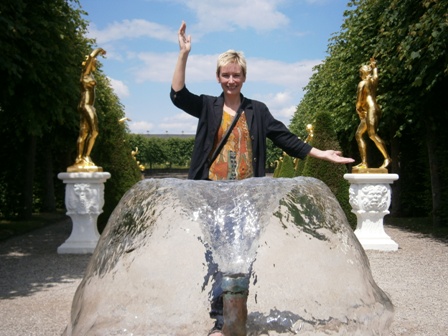
Anyway we also spent a great day at the Herrenhaus Gardens, which are a massive formal garden, formerly part of the royal summer residence of King Georg 1st, with fountains, mazes, statues, intricately sculptured garden beds, amphitheatres, waterfalls, hedged groves, glass-lined grottos - and a festival. Wherever we went there were musician’s chairs set up, but we did not catch any actual music, bar the overflow sound from a couple of other festivals nearby! Across the road is the botanic gardens where we toured the glasshouses of cacti and ferns. The orchid house was also home to a flock of zebra finches and diamond finches, which was a lovely touch of Australia.
Another city, another transport system to conquer. This one had us fooled though. Looking for the tram we need and it is just not there. The other trams appear to be roughly where we expect. Nearly lost my faith in my map navigation skills. Forgot about 3D didn’t I. The tram stop eventually turned out to under our feet. Never really thought about underground trams before, but I guess it’s logical. Actually, there is a lot of these cities underground. Long malls and interconnecting walkways throughout the city centre. It’s another world down there.

Really sorry to miss Andreas in Hamlyn nearby. Unfortunately he went away for the long weekend, and we could not wait till Monday night to see him. Anyway we did manage to post the chillie sauce to him from his mum.

Now travelling to Copenhagen. Finally found the schedule in the Eurail timetable -spelt Kobenhaven. Didn’t looked for it under K! couldn’t understand why Eurail didn’t include Denmark especially as it was on our ticket.

Love Sandy & Anna

Sunday, 12 June 2011

Munich, Germany

Interesting introduction to Munich, arriving at 7pm to find our first night’s hotel booking had gone awry and the town was full to overflowing with 75,000 visitors to the Intersolar Exhibition. Complicated somewhat by leaving our booking confirmation in the information centre while we were looking for the hotel. When we went back for it, the next customer had taken it with them. The backup copy was meant to be on the website, but there was no sign of it. The nearest available accommodation was 125km away for a 200 Euro taxi ride and their phone was not working.

So we resigned ourselves to exploring the nightlife of Munich and raging all night. That included dinner at 10.30 while watching a local soccer match, a fruitless search for the cinema, a stiff drink in a nice hookah café at 1am and 3 hours of fun playing the roulette machine at an all night casino for a total investment of 10 Euros – with free coffees. We started with a winning streak turning our 10 euro investment into a 50 euro win which we spent the rest of the night losing on all the other pokie machine games on offer before returning to roulette to win our original stake back. Considering I have never understood pokies in English let alone in German we did very well.

The Exhibition was huge, with 15 halls about the size of the Adelaide convention centre and 2200 exhibitors. The larger ones had full bars and had built mezzanine floors with offices to do business in a relaxed way. At the close of the day, some hosted rock bands for the chosen to party on.

Anna survived two halls before retiring to the coffee shop as her foot had had enough from being up all night. We took the afternoon sleeping before tackling the local Bierhaus and some Bavarian food. For some reason pork does not sound quite so appetising when it is called schweinfleish, but we had a great meal – and then slept for 12 hours.

Next day Anna tackled the 3 Pinketheke –art galleries – the  Alte /old, the neue/new,  including Van Gogh’s Sunflowers, and the new modern, which includes galleries on design and architecture and is housed in an impressive vast building, while Sandy took on some more of the exhibition, looking at the latest solar technology. Some highlights were the off-grid and rural electrification companies, the combined solar PV and solar water heating modules, plastic film flexible solar modules, high temperature hot water panels to run chillers for cooling. He also talked to the various PV module testing and certification companies.

We found another Bierhaus for dinner which was enormous, and staffed by old gentlemen carrying heavy trays of beer steins on their shoulders. Anna claims never to have seen Sandy drink so much beer. Honest, it was only one, but it was large. We are still puzzling over the hotel bed, which was two singles put together, and fitted with individual bedding. When we asked for a double sheet the staff rolled their eyes and said it was not possible. Oh well!

The next day Anna took off to the Alps to visit King Ludwig II’s fairytale castle Neuschswanstein – the castle Disney based his Sleeping Beauty castle on, set on top of a relatively small mountain at the foot of the alps across the valley from the Royal summer castle. Unfortunately the Alps were shrouded in cloud all day but the foothills were very impressive as was the beautiful castle, although it is only a third finished inside as work halted after the King’s untimely death in mysterious circumstances and it became a museum just 6 weeks later. It is a tribute to visionary artistic expression without regard to constraints like budgets.

After 2 excellent German dinners we went in search of different fare and found that a Chinese menu in German held no appeal, while the Italian menu sounded delicious and so we enjoyed the best meal of many good meals so far in Ein italienisches restaurant – which also solved for Anna the mystery of why the German language course teaches travellers to ask for an Italian restaurant in Germany.

And so we are travelling today to Hanover on the ICE train past many large solar power systems in fields and on the steep roofs of houses barns and businesses – an interesting juxtaposition to the huge stacks of firewood alongside – a mix of old and new technologies.  

Thursday, 9 June 2011

D'Amsterdam

Minen Damen und Herren is the phrase that begins every announcement since we arrived in Amsterdam 2 days ago having been unable to resist the lure of this enchanting part of Europe. Every time we decided we were too short of time for Amsterdam we saw an article or had a first hand report on how charming it is and so we had to go. And well worth the trip it is.

We had a bit of a turbulent introduction to rail travel in Europe getting to Amsterdam when the second of our 2 trains broke down one stop out of Brussels. We got on another train and then changed trains again as planned. However this train was so full it was standing room only even in first class and we found ourselves wedged into the overflow section of our carriage along with 8 other travellers and the kiosk for at your seat service – and that was not going anywhere on that trip. The kiosk operator told us that if we got off this train at I forget where already and wait for the second train going to Amsterdam to come to platform 16 we would have a more comfortable trip and also arrive before the current train as our new train would not be stopping everywhere.

We decided to take her advice, spent a sort of anxious 15 minutes feeling a bit stranded in the middle of somewhere but not knowing exactly where until the predicted train arrived and was everything she’d promised, and so we finished our trip in first class comfort.

The Dutch desire for canal frontage property  combined with the inability of most to afford very much of it resulted  in rows of very narrow very tall houses which over the centuries have leaned this way and that to an alarming degree. This is the place where the crooked man built his crooked house.

Somehow they manage to prop each other up and stay standing with the aid of some modern engineering – every house has metal bolts through the walls. Each house is equipped with a built in crane at the roof so furniture can be hauled up the outside and through the windows as no space was allowed between or within for such things. The stairs are also extremely steep and narrow to save space. (see photo of our Hotel stairs to reception).

These rows of tilting architectural wonders fringe a network of canals lined with numerous boats and house boats of infinite variety. Between the houses and the water are narrow streets lined with parked cars and bikes. Every block has a bridge over the next canal and every bridge railing is lined with bikes.
We decided that half the bikes are abandoned since they had flat tires or rusting frames but there never seemed to be any fewer bikes parked anywhere no matter how many cyclists there were. The overall effect was to me one of a ramshackle and easy going place. Amsterdam was blessedly free of queues and crowds and despite having an incomprehensible (to me) tram system we really appreciated instant access to everything once we found it. Between the bikes and the trams and busses there is not much traffic and the single lane roads seemed enough for easy driving.

As we had no reservations the first thing was to find a room and we did this easily through matching a Lonely Planet recommendation of Nadia Hotel to an entry at the automated info booth in the station. Unable to phone we hailed a cab and just turned up – the stair case was indeed precipitous and the energetic staff did haul our bags up it for us cheerfully informing us on the way that exercise was included free of charge. 10 minutes and a complementary welcome drink later we had a charming room on the third floor with a stunning view of the canal and Westkirke – which meant our bed-side clock was on a clock tower just out the window and we were treated to discordant chimes every 15 minutes and a lengthy melody with the hour bells every half hour – Listen though we did we could never figure if it was the same tune twice and I was relieved that it faded into the background at night and did not wake us once.

Thus provided for we headed out to downtown Amsterdam where surprisingly we found a beach volleyball tournament in its final stages in the city square and a stall selling proffetjes with strawberries. (tiny pancakes) YUMMMM and would you believe one of our favourite buskers from Rundle Mall Lindsay Buckland was providing the ambiance. After a short walk down the main street to the station we hopped on a canal tour just like that and set off to see the sights and then finished the day with schnitzels and gypsy sauce the closest we could find to a local cuisine. The next day we found a lot of even quirkier aspects of Amsterdam including this wonderful shop – get your head around this pic.

As I write we are rocketing through Germany at 298kph on the ICE train very glad we went to Amsterdam and there I will leave you til next time as once again time has run out.


Sunday, 5 June 2011

Goodbye Paris now with photos


Thoroughly enjoyed our 4 days in Paris, starting with the Eiffel tower on the first evening. Walked the 115m up to the second level! The surprising thing was the large crowds gathered on the lawns for 400m either side to watch the hourly light show of 20,000 white lights sparkling all over the tower.

Spent much of the next day at the Louvre. General themes of love, death and war it seems - but not much of the first really. The Roman statues were very interesting, particularly the use of different stones to create clothing. The Moulin Rouge was excellent. A really good range of acts from the signature topless (mixed) dancing to the 7-baton juggler and the ventriloquist using 4 members of the audience and a dog as his dummies.

Boy its a struggle to get enough sleep on this trip - let alone keeping up with the blog! Looks like the train to Amsterdam on Sunday is our best bet to catch up.

The penalty is that we can never get up early enough to beat the queues at the Musee D'Orsay, and its not even peak season yet. Gave up after 2 or 3 tries - life is too short for long queues, and Anna has already seen the highlights in Canberra(?)

Spent the next day at the Pompidou Centre of modern art. Looks very much like Sandy's interest is sculpture, not painting, and enjoyed a great exhibition by Francois Morellet using neon lights, black  lines and timber.
 A great evening in Montparnasse district, eating at Japanese shaslick-style meal.

We paid final regards to the Eiffel Tower on our last night.

Norfolk

Diss is a small town in Norfolk, where we are staying for a few days with our friends Sandie and Michael. We arrived in time for daughter Emma’s wedding which was a beautiful ceremony, reception and party in rolling hills near Norwich.

We spent a day exploring the area including the steam train ride from Sheringham to Holt, and a boat cruise on the Norfolk Broads. The Broads are an extensive system of rivers and maybe 200 lakes which are navigable for 30-40km inland. The lakes are formed from medieval peat mines near the rivers which have since been flooded.

You can hire various types of boat for the hour, the day or the week. Luckily we are here before the peak season as it becomes so popular you cannot move according to the locals. We had a great alfresco pub lunch overlooking the Broads at Wroxton.

The weather has been mild to warm right through the long days. It was fully light this morning when I woke up at 4.15am and it is still light at 9.30pm.